7 Powerful Things Your PMS and Perimenopause Symptoms May Be Telling You
If you have ever felt like your body becomes louder before your period, I want you to know something very important: your PMS is not a personality flaw.
It is not a sign that you are weak. It is not proof that you are too emotional. It is not something you should automatically dismiss just because it happens every month.
Your symptoms may be information.
In my recent live stream, I talked about PMS and perimenopause because I often see them as deeply connected seasons in a woman’s hormonal life. PMS can sometimes be an early signal of the patterns that become more noticeable during perimenopause. The cramps, bloating, irritability, fatigue, gut symptoms, headaches, and emotional intensity that show up before your period can become stronger when hormones begin shifting in a less predictable way.
That does not mean your body is failing.
It means your body is communicating.
In Western medicine, I look at hormones. I look at progesterone, estrogen, the relationship between them, the timing of symptoms, the regularity of the cycle, and how your body responds through the month. In Chinese medicine, I also look at the liver, because the liver is connected with the smooth flow of energy throughout the body.
When that flow is not smooth, symptoms may appear in the menstrual cycle, digestion, mood, muscles, shoulders, head, and nervous system.
This is why PMS and perimenopause deserve a whole-body conversation.
Why I Connect PMS and Perimenopause
PMS and perimenopause are not the same thing, but they can be connected.
PMS usually refers to symptoms that appear before the menstrual period and improve when bleeding begins or shortly after. These symptoms may be physical, emotional, digestive, or mental. Many women experience cramps, bloating, breast tenderness, fatigue, irritability, sadness, anxiety, sleep changes, food cravings, or headaches.
Perimenopause is the transition before menopause. During this time, hormone patterns can become less predictable. Your cycle may become shorter, longer, heavier, lighter, or irregular. You may begin to notice sleep disruption, mood changes, hot flashes, night sweats, brain fog, or shifts in energy.
For some women, perimenopause feels like PMS turned up louder.
A symptom that used to be mild can suddenly feel stronger. A mood shift that used to last one day may last several days. Bloating may become more obvious. Fatigue may become harder to push through. The emotional intensity may feel surprising, especially for women who used to feel very steady.
When this happens, it’s helpful for you to ask yourself some important questions about your body.
- What changed in the rhythm of your body?
- What is happening hormonally?
- Where is stress being held?
- What is digestion doing?
- Is the body inflamed, depleted, stuck, overwhelmed, or under-supported?
These questions are the beginning of healing.
The Chinese Medicine View: The Liver Regulates Smooth Flow
In Chinese medicine, the liver has a much broader meaning than the physical liver alone.
Of course, the liver is an important organ in Western medicine. It helps with detoxification, metabolism, bile production, nutrient processing, and many other essential functions. But in Chinese medicine, the liver is also understood as a system of movement, regulation, and flow.
The liver is connected with the smooth flow of energy through the whole body. It influences menstrual rhythm, digestion, emotional expression, tension, anger, motivation, and the places where we feel stuck.
When liver energy is flowing smoothly, the body often feels more flexible and regulated. The cycle may feel easier. Emotions may move through instead of building up. Digestion may feel less reactive. Tension may not settle so strongly in the shoulders, neck, or head.
When liver energy is not flowing smoothly, symptoms can show up.
With PMS you might feel more tension in your body a few days before your period, Digestive issues such as irritable bowel could worsen. The breasts may feel tender. Emotions may feel sharper and more irritable. It’s more likely to get migraines or headaches. Sleep may feel less restful.
In Chinese medicine, this can point to a pattern of stagnation, which simply means the flow is not moving freely.
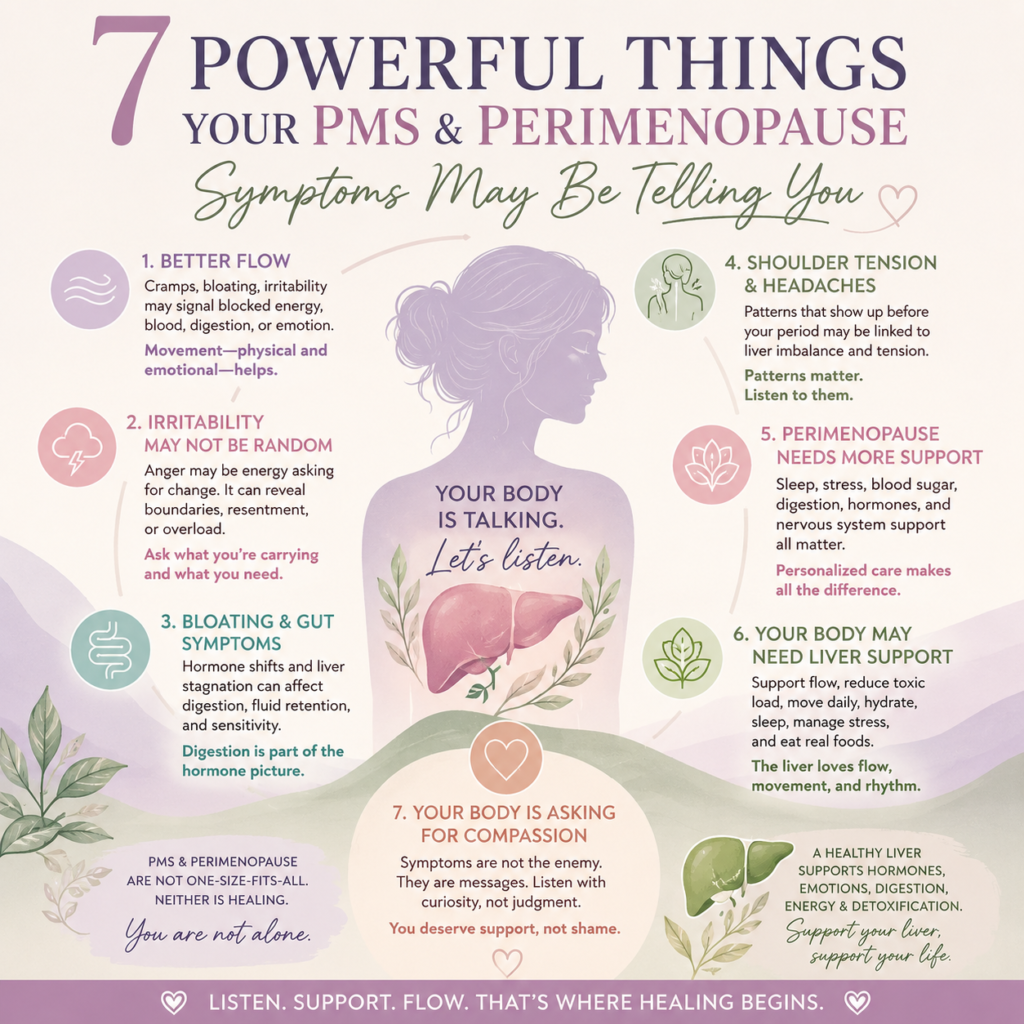
1. Your PMS May Be Asking for Better Flow
One of the most powerful reframes I can offer is this:
PMS may be about energy flow.
If you have cramps, bloating, irritability, or pressure before your period, your body may be showing you that energy, blood, digestion, emotion, and hormones are not moving as smoothly as they could.
This is why movement can help some women. Gentle walking, stretching, yoga, breathing, or simply creating space in your schedule before the period may support the body. But movement is not only physical. Emotional flow matters too.
If you are holding everything in, saying yes when you mean no, carrying too much responsibility, or suppressing anger, the premenstrual phase may reveal what the rest of the month has hidden.
Your body may say, “I cannot hold this anymore.”
That message deserves compassion.
2. Your Irritability May Not Be Random
Many women feel ashamed of irritability before their period. They say things like, “I do not know why I am so angry,” or “I hate how I become before my cycle.”
I want to soften that shame.
In Chinese medicine, the liver is connected with anger and the need to move forward. Anger is not always bad. Sometimes anger is energy that wants to create change. It can show us where a boundary has been crossed, where resentment has built, or where the body has been under too much pressure for too long.
During PMS and perimenopause, hormone shifts can make the nervous system more sensitive. At the same time, liver energy stagnation may make emotions feel more compressed. When those two things meet, irritability can rise quickly.
The goal is not to judge the emotion. The goal is to understand what it is trying to protect or reveal.
Ask yourself:
- What am I carrying that feels too heavy?
- Where do I need more support?
- What have I been tolerating for too long?
- What does my body need before my period begins?
These are not small questions. They are healing questions.
3. Your Bloating and Gut Symptoms May Be Part of the Hormone Picture
PMS is not only emotional. Many women notice that digestion changes before the period.
You may feel bloated. Your bowels may change. You may feel more sensitive to foods. You may feel heavy, tight, or uncomfortable in the abdomen.
In Chinese medicine, the liver can affect digestion when its flow becomes stuck. The liver and digestive system influence each other. When stress rises or energy stagnates, digestion may become more reactive.
In Western medicine, we also know that hormone shifts can influence fluid retention, gut motility, inflammation, and sensitivity. This is why the same meal may feel fine one week and uncomfortable the week before your period.
If this is happening, do not only ask, “What food caused this?”
Also ask:
- Where am I in my cycle?
- How is my stress?
- Am I sleeping well?
- Am I constipated?
- Am I eating regularly?
- Is my body asking for lighter, warmer, easier-to-digest foods before my period?
PMS and perimenopause remind us that digestion is not separate from hormones. It is part of the whole system.
4. Your Shoulder Tension and Headaches May Be Connected
In the live stream, I also mentioned that liver imbalance in Chinese medicine may show up in tension patterns, especially shoulder tension, headaches, or migraines.
This is one of the reasons I always listen carefully when a woman tells me, “Before my period, my shoulders tighten,” or “I always get headaches before my cycle.”
The body often gives us clues through patterns.
A headache that appears randomly once may not tell us much. But a headache that appears repeatedly before the period tells us the cycle is involved. Shoulder tension that always increases premenstrually may tell us that the body is holding stress and stagnation in a predictable way.
This does not mean every headache is a liver energy issue. Severe, new, unusual, or worsening headaches should always be evaluated medically.
But when symptoms follow a menstrual pattern, that pattern matters.
5. Your Perimenopause Symptoms May Be Asking for a New Level of Support
Perimenopause is not a failure. It is a transition.
But many women enter it without enough support because they are told to wait until menopause, push through, or accept symptoms as normal.
I do not believe women should be dismissed during perimenopause.
This is a time when the body may need more thoughtful care. Sleep may need support. Stress may need support. Blood sugar may need support. Digestion may need support. The liver may need support. Hormones may need support. The nervous system may need support.
Some women benefit from acupuncture. Some benefit from Chinese herbs. Some benefit from progesterone support or other medically guided hormone approaches. Some need nutrition changes. Some need better sleep rhythms. Some need boundaries and emotional support.
Many need a combination.
The key is personalization.
PMS and perimenopause are not one-size-fits-all experiences, so the support should not be one-size-fits-all either.
Read our blog about “Healing Shoulder Injuries” for my health help tips.
6. Your Body May Need Liver Support
In Chinese medicine, spring is the season connected with the liver. That is one reason I often talk about seasonal rebooting, cleansing, or detox support in spring.
But liver support does not have to mean extreme detoxing. In fact, I do not like aggressive approaches that leave people depleted.
Supporting the liver can be gentle.
It may include:
- Eating more colorful vegetables
- Supporting regular bowel movements
- Reducing alcohol if it worsens symptoms
- Staying hydrated
- Moving the body daily
- Sweating appropriately if your body tolerates it
- Breathing deeply
- Reducing toxic load where possible
- Sleeping earlier
- Creating emotional space
- Working with herbs or supplements only when appropriate
The liver loves flow. It loves movement. It loves rhythm. It loves not being overburdened.
When I talk about liver support, I am talking about helping the body do what it already knows how to do, but with less resistance and more nourishment.
Read about “Preventable liver disease is rising: What you eat — and avoid — counts” from an article from Harvard Health Publishing.
7. Your Symptoms May Be Inviting You to Receive Help
One of the most important messages I want to share is this:
You do not have to figure this out alone.
If your PMS is affecting your relationships, work, energy, sleep, mood, or quality of life, please reach out for support. If perimenopause is making you feel unlike yourself, please do not wait until you are completely depleted.
There are many ways to support the body.
Acupuncture can be helpful for many women because it works with the body’s flow and regulation. Chinese herbs may also be helpful when chosen carefully and individually. Hormone support, including progesterone support for some women, may be appropriate when guided by a clinician. Lifestyle changes can make a meaningful difference. Stress care is not optional. Sleep is medicine. Digestion matters. Emotional truth matters.
The body is not a collection of separate parts.
It is made up of connected systems that are in communication with one another.
A Simple Acupressure Practice Around the Knee
In the live stream, I demonstrated a simple way to massage points around the knee that are traditionally used in Chinese medicine to support hormone balance and menstrual comfort.
Here is something you can try to help support your hormones.
Sit comfortably. Place your hands around one knee. Find the soft area just below the knee on the inner side. Gently press or massage. Then find the soft area just below the knee on the outer side. Gently press or massage there too. Then move a couple of fingers above the knee, before the bony area begins, and look for a tender point. Massage gently.
Use soft pressure. Do not force it. Breathe slowly.
You can spend one to two minutes on each knee. If an area is tender, be kind to it. Tenderness often tells us the body is asking for attention, not aggression.
This practice does not replace acupuncture or medical care, but it can be a beautiful way to connect with your body and support the idea of flow.
If You Only Do One Thing
If you only do one thing after reading this, track your symptoms for one full cycle.
Write down:
When symptoms begin
What symptoms show up
How intense they feel
What happens with digestion
What happens with mood
What happens with sleep
What happens with cravings
What happens with energy
When symptoms improve
This simple practice can be incredibly powerful.
Instead of feeling surprised by your body every month, you begin to see the pattern. Once you see the pattern, you can support it earlier.
For example, if you know your irritability begins five days before your period, you can plan gentler evenings, lighter commitments, earlier sleep, more movement, acupuncture, or extra support before that window begins.
This is not about fear. It is about preparation and compassion.
Common Mistakes Women Make With PMS and Perimenopause
Mistake 1: Believing PMS Is Just Something to Endure
PMS may be common, but that does not mean suffering should be ignored. If symptoms disrupt your life, they deserve attention.
Mistake 2: Blaming Yourself for Mood Changes
Mood symptoms may reflect hormone shifts, nervous system sensitivity, stress load, and liver energy stagnation. Blame does not heal. Understanding does.
Mistake 3: Waiting Until Symptoms Are Severe
Support often works better when you start before symptoms peak. If you know your pattern, you can care for your body earlier.
Mistake 4: Looking Only at Hormones
Hormones matter, but so do digestion, stress, sleep, liver support, inflammation, nutrition, and emotional flow.
Mistake 5: Using Herbs or Hormones Without Guidance
Natural does not always mean appropriate for everyone. Chinese herbs, supplements, and hormones should be personalized, especially if you take medications or have medical conditions.
Frequently Asked Questions (FAQs)
1. Can PMS get worse during perimenopause?
Yes, it can. As hormones become less predictable during perimenopause, some women notice that PMS symptoms become stronger, longer, or more disruptive.
2. What does liver energy mean in Chinese medicine?
Liver energy refers to a Chinese medicine concept related to smooth flow, menstrual regulation, digestion, emotion, tension, and movement. It is not exactly the same as the physical liver in Western medicine, but the two perspectives can complement each other.
3. Can acupuncture help PMS and perimenopause symptoms?
Acupuncture may help support regulation, flow, stress response, and cycle-related patterns for some women. It should be performed by a qualified practitioner and used as part of a personalized plan.
4. Is progesterone always needed for PMS?
No. Some women may benefit from progesterone support, especially when symptoms suggest low progesterone relative to estrogen, but it is not for everyone. This should be discussed with a clinician.
5. When should I seek medical care?
Please seek medical support if PMS or perimenopause symptoms interfere with your daily life, relationships, sleep, mood, work, or overall functioning. Seek urgent help if you experience severe depression, thoughts of self-harm, unusually heavy bleeding, severe pain, fainting, chest pain, or new neurological symptoms.
Final Thoughts
PMS and perimenopause are not signs that your body is broken.
They are invitations to listen.
Your cramps, bloating, irritability, fatigue, headaches, digestive symptoms, and emotional intensity may be asking for more flow, more support, more rhythm, and more compassion.
In Western medicine, we can look at hormones. In Chinese medicine, we can look at liver energy. In integrative medicine, we can bring these views together and ask what your whole body needs.
You do not have to suffer silently.
If this message speaks to you, I invite you to watch the full live stream, follow Heart to Heart Medical Center for more integrative health education, or schedule a free consult so we can talk about what kind of support may be right for you.
Educational only, not personal medical advice.