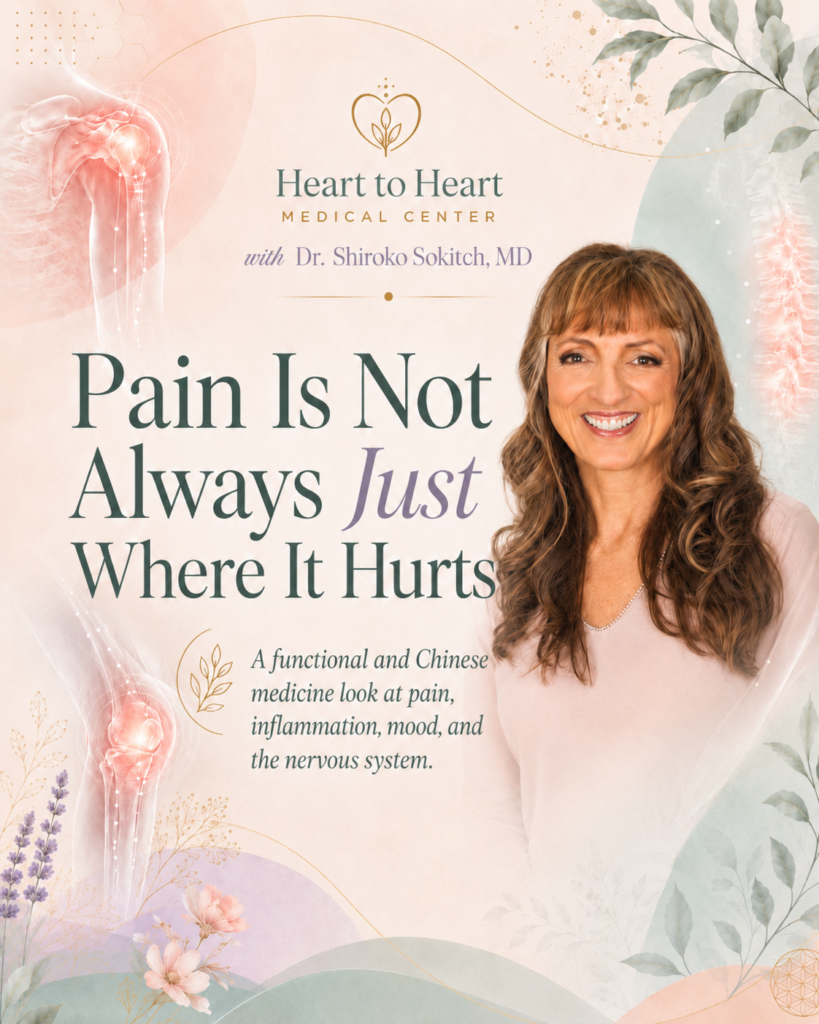
Pain Is Not Always Just Where It Hurts
Pain and inflammation can be deeply frustrating, especially when pain lasts longer than expected or keeps returning even after you have tried to feel better. Sometimes pain begins with something obvious, like a sprained ankle, an injury, a flare-up after stress, or a physical strain. Other times, it appears gradually and becomes part of daily life.
What I want you to understand is this: pain is not always just about the place that hurts.
In my live stream, I talked about pain and inflammation through both functional medicine and Chinese medicine because these two systems can beautifully inform one another. Chinese medicine gives us a language of movement, flow, stagnation, nourishment, and spirit. Functional medicine gives us a language of inflammation, nervous system pathways, neurotransmitters, hormones, immune signaling, and recovery.
When we bring those perspectives together, we can begin to see chronic pain not as a personal failure, but as a message from the body. Pain may be asking us to look deeper. It may be asking us to support movement, inflammation, mood, nervous system regulation, and the body’s rest-and-recover pathways.
This is not about replacing appropriate medical evaluation. If you have severe, sudden, worsening, or unexplained pain, it is important to seek medical care. But for many people living with ongoing pain and inflammation, a wider lens can be incredibly helpful.
The Chinese Medicine View: Pain Often Means Something Is Stuck
In Chinese medicine, pain is often understood as energy that is not moving freely. The body is designed for movement. Energy moves. Blood moves. Fluids move. Breath moves. Digestion moves. Emotions move. Communication between organs and systems is meant to move.
When pain appears, Chinese medicine often asks: where has the flow become blocked?
This is the concept of stagnation. Stagnation simply means that something is not moving smoothly. It may show up as physical pain, tightness, tension, irritability, frustration, pressure, or a sense that the body is holding onto something.
In Chinese medicine, the liver is especially connected to the smooth flow of energy throughout the body. When liver energy is moving well, there is a greater sense of flow and ease. When it is stuck, people may feel pain, tension, emotional frustration, or a sense of being blocked.
This does not mean the pain is imaginary. It means the painful area may be part of a larger pattern. The area that hurts is important, but the whole body context is also important.
For example, two people may have a similar injury. One person may recover quickly, especially if the body receives the right support early. Another person may continue to have pain long after the original injury should have improved. From a Chinese medicine perspective, that lingering pain may suggest that energy, blood, or communication in that area has become stuck.
This is one reason acupuncture is so important in Chinese medicine. Acupuncture is often used to help move stuck energy, support circulation, calm the nervous system, and encourage the body to reconnect with its own healing rhythms.
When Pain Becomes Chronic, the Body Can Become Depleted
Pain and inflammation can change over time. At first, pain may feel local. It may be in the neck, back, shoulder, knee, hip, wrist, or ankle. But when pain lasts a long time, it can begin to affect the whole person.
In Chinese medicine, long-standing pain may eventually contribute to a deeper kind of depletion. One way this may be described is blood deficiency. In Chinese medicine, blood does not mean exactly the same thing as blood in Western medicine. It includes nourishment, moistening, grounding, emotional steadiness, and support for the heart, liver, and spirit.
This is why chronic pain can feel so draining. It may not only hurt physically. It may make you feel emotionally worn down, less resilient, less steady, or less connected to your normal sense of self.
Many people with chronic pain feel guilt or shame because they cannot “just get over it.” But the body is not a machine. When pain and inflammation persist, the nervous system, immune system, mood chemistry, digestion, sleep, and stress response can all become involved.
The deeper question becomes: what does the body need in order to feel nourished again?
Sometimes it needs movement. Sometimes it needs rest. Sometimes it needs support for inflammation. Sometimes it needs nervous system regulation. Sometimes it needs acupuncture, herbs, nutrients, or a more complete clinical evaluation.
The point is not to blame the body. The point is to listen more carefully. Read more about Harvard Health’s 8 Non-Invasive Pain Relief Techniques.
The Functional Medicine View: Inflammation Can Affect Mood, Memory, and Recovery
Functional medicine gives us another helpful way to understand pain and inflammation. When inflammation lasts for a long time, it may affect more than the painful area. It may influence immune signaling, hormone rhythm, neurotransmitter pathways, and the nervous system.
One example I discussed in the live stream is tryptophan. Tryptophan is a precursor to serotonin, which is connected to mood, emotional well-being, and a sense of steadiness. When inflammation is present for a long time, tryptophan may be redirected into inflammatory pathways. This may involve compounds such as kynurenine or quinolinic acid.
When this happens, some people may feel more depleted, depressed, foggy, or emotionally flat. Their nervous system may feel inflamed or less resilient. They may notice poor memory, difficulty concentrating, fatigue, low motivation, or the feeling that their body cannot fully recover.
This does not mean every person with chronic pain has the exact same chemistry. It means pain and inflammation can affect the body in many interconnected ways.
This is where functional medicine can be valuable. Instead of asking only, “Where is the pain?” we may also ask:
What inflammatory markers are elevated? What is happening with nutrient status? How is the stress response functioning? Is the nervous system overactivated? Are mood pathways being affected? Is sleep restorative? Is digestion contributing to inflammation? Is the body able to return to rest-and-recover mode?
These questions do not replace conventional care. They expand the conversation.
The Vagus Nerve and the Rest-and-Recover System
The vagus nerve is one of the most important parts of the rest-and-recover system. It begins in the brain and travels through the neck, heart, lungs, digestive system, and many organs. It helps the body shift toward regulation, digestion, recovery, and repair.
When inflammation becomes chronic, the nervous system may become less flexible. This can make it harder for the body to settle. You may feel wired but tired. You may feel foggy, tense, emotionally reactive, or unable to fully rest.
This is why chronic pain support should include the nervous system.
The body heals best when it feels safe enough to recover. If the nervous system is constantly receiving danger signals, the pain experience can intensify. Supporting vagal tone, breathing, rest, gentle movement, sleep, and stress regulation can be an important part of an integrative pain plan.
Again, this does not mean pain is “all in your head.” It means your head, heart, immune system, hormones, digestion, and nervous system are all connected.
Dopamine, Joy, and the Feeling of Wanting Relief
Another important piece of pain and inflammation is dopamine. Dopamine is connected to motivation, reward, pleasure, and forward movement. When inflammation and stress affect the nervous system, dopamine signaling may become less effective.
This may feel like wanting something but not being able to feel satisfied. You might try exercise, work, food, scrolling, stimulation, or other sources of temporary relief. Some of those may help for a short time. But if the deeper pattern is not supported, fatigue and pain may return.
In Chinese medicine, this can resemble liver qi stagnation: wanting movement but feeling stuck.
This is such an important reframe because it helps reduce shame. When people are in chronic pain, they often judge themselves for not feeling motivated, joyful, productive, or emotionally balanced. But those changes may be part of the inflammatory and nervous system picture.
The body may not need more judgment. It may need more support. Read more about 7 Powerful Natural Allergy Relief: How to Support Your Lungs and Stop Seasonal Allergies.
Common Mistakes People Make With Pain and Inflammation
Mistake 1: Only focusing on the painful area.
The painful area matters. It should be evaluated. But chronic pain may also involve inflammation, stress, nervous system regulation, sleep, digestion, mood pathways, and recovery capacity.
Mistake 2: Ignoring mood changes.
If pain has affected your mood, that does not mean you are weak. It may mean your body is carrying inflammation, depletion, or nervous system stress.
Mistake 3: Chasing only temporary relief.
Temporary relief can be valuable, but if pain keeps returning, it may be time to ask what deeper pathway needs support.
Mistake 4: Waiting too long to support the nervous system.
The nervous system is not separate from pain. Supporting regulation, vagal tone, and recovery can be an important part of healing.
Mistake 5: Treating Chinese medicine and functional medicine as separate worlds.
They can work together. One system may explain what the body is expressing energetically. Another may explain what is happening biochemically. Together, they can help us see the whole person.
Practical Support: What an Integrative Plan May Include
An integrative plan for pain and inflammation should always be individualized. There is no one-size-fits-all answer. However, there are several areas I often consider.
1. Acupuncture to help move stuck energy.
Acupuncture may support movement, circulation, nervous system calming, and relief from stagnation. It is one of the primary tools in Chinese medicine for addressing pain patterns.
2. Nervous system support.
This may include breathing practices, vagus nerve support, gentle movement, rest, sleep support, meditation, somatic awareness, and reducing the constant danger signals that keep the body on alert.
3. Inflammation support.
Functional medicine may look at lifestyle, hormones, digestion, immune signaling, nutrient levels, toxins, infections, stress, and other contributors to inflammation.
4. Cortisol rhythm support.
Cortisol is part of the stress response. When stress has been high for too long, the body may have a harder time recovering. Supporting healthy rhythm can be important.
5. Herbs and supplements when appropriate.
Herbs and supplements can be helpful, but they should be personalized. This is especially important if someone takes medications, has medical conditions, or is dealing with complex symptoms.
6. Clinical testing when needed.
In some cases, blood or urine testing may help evaluate inflammatory markers, nutrient status, or pathways related to tryptophan and nervous system inflammation.
7. A compassionate relationship with the body.
This is not a small thing. When you stop seeing your body as the enemy, your healing process can become more grounded, informed, and sustainable.
If You Only Do One Thing
If you only do one thing after reading this, stop judging your pain as a personal failure.
Ask a better question:
What is my body trying to communicate?
That question can open the door to a different kind of healing conversation. Instead of fighting the body, you begin listening to it. Instead of only chasing symptoms, you begin looking for patterns. Instead of asking for one quick fix, you begin supporting the pathways that help the body regulate and recover.
A Simple One-Minute Body Check-In
Place one hand over your heart and one hand near the area of discomfort if that feels comfortable.
Take three slow breaths.
Ask yourself:
What feels stuck?
What feels depleted?
What kind of support does my body need today?
This is not a replacement for medical care. It is a way to begin listening to your body with more compassion and curiosity.
FAQs About Pain and Inflammation
1. Is pain and inflammation always a sign of serious disease?
Not always. Pain and inflammation can have many causes. Some are temporary and resolve with appropriate care. Others need medical evaluation. Sudden, severe, worsening, or unexplained pain should be checked by a qualified clinician.
2. What does Chinese medicine mean when it says pain is stuck energy?
It means that movement and flow in the body are not happening smoothly. This may involve energy, circulation, fluids, communication, or the body’s ability to recover.
3. Can inflammation really affect mood?
In many cases, chronic inflammation may influence pathways connected to mood, neurotransmitters, and nervous system function. This is one reason pain can feel physically and emotionally exhausting.
4. Can acupuncture help with pain and inflammation?
Acupuncture is commonly used in Chinese medicine to help move stagnation, support regulation, and address pain patterns. Results vary by person, and care should be individualized.
5. Should I take supplements for inflammation?
Supplements should be personalized. It is best to work with a qualified clinician, especially if you take medications, are pregnant, have medical conditions, or have complex symptoms.
6. What does the vagus nerve have to do with pain?
The vagus nerve helps support rest, digestion, recovery, and nervous system regulation. When the nervous system is stressed or inflamed, pain and recovery may be affected.
7. Why do I feel foggy when my pain flares?
Brain fog may occur for many reasons, including inflammation, sleep disruption, stress, nervous system strain, and biochemical changes. It is worth discussing with a clinician if it is persistent.
Pain Is Information
Pain and inflammation are not always simple. They can involve the painful area, but they may also involve energy flow, immune signaling, mood pathways, nervous system regulation, vagal tone, cortisol rhythm, and the body’s ability to recover.
This is why an integrative lens can be so powerful.
Chinese medicine helps us ask: where is the body stuck?
Functional medicine helps us ask: what pathways need support?
Together, they help us ask: what does this whole person need in order to move, nourish, regulate, and heal?
If you are dealing with chronic pain and inflammation, please know this: your body is not broken. Your body is communicating. And with the right support, it may be possible to create more movement, regulation, resilience, and relief.
If pain and inflammation have been affecting your energy, mood, focus, or quality of life, I invite you to follow Heart to Heart Medical Center, subscribe to my newsletter, or book a consultation to explore a more personalized integrative approach.
Educational only, not medical advice. Please work with your trusted clinician for individualized care.