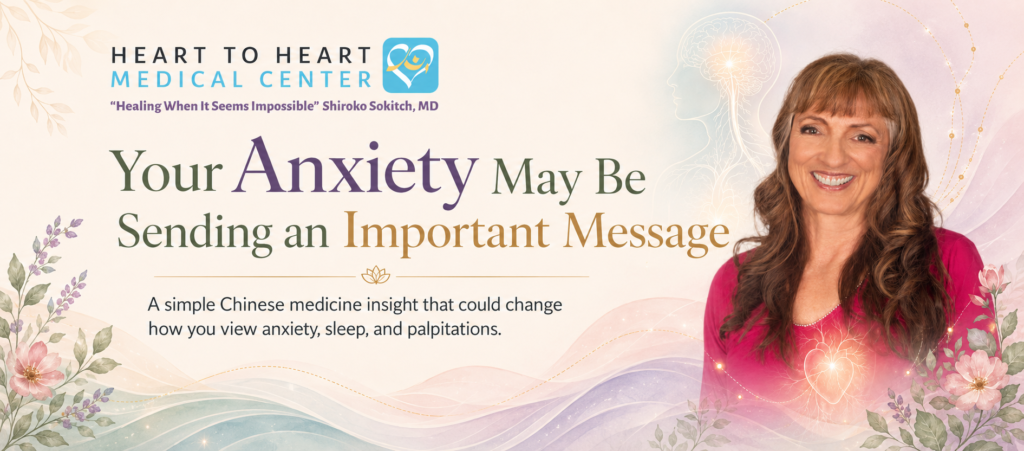
Anxiety and Heart Palpitations: Could Your Body Be Sending an Important Message?
Have you ever felt your heart racing for no apparent reason?
Perhaps you have experienced a fluttering sensation in your chest while lying awake at night, unable to stop worrying. Maybe you have found yourself trapped in a cycle where anxiety causes heart palpitations, and the palpitations create even more anxiety.
If this sounds familiar, you are far from alone.
Anxiety and heart palpitations are among the most common complaints seen in both conventional and integrative medical practices. Yet many people never realize how closely these symptoms are connected.
During a recent live discussion, Dr. Shiroko Sokitch shared a fascinating perspective from Chinese medicine that may help us understand why anxiety, poor sleep, emotional overwhelm, mental fog, and heart palpitations often appear together.
What makes this perspective particularly compelling is that modern scientific research is increasingly discovering many of the same connections that traditional Chinese medicine has described for centuries.
Why Anxiety and Heart Palpitations Often Occur Together
One of the most common questions patients ask is:
“Can anxiety really cause heart palpitations?”
The answer is yes.
In fact, medical research has shown that anxiety disorders account for a significant percentage of palpitation-related medical visits.
When the brain perceives stress, the autonomic nervous system activates what is commonly known as the fight-or-flight response.
This response increases:
- Heart rate
- Blood pressure
- Stress hormone production
- Muscle tension
- Mental alertness
These changes are designed to protect us during danger.
The problem is that modern life often keeps the stress response activated long after the threat has passed.
Financial pressures.
Relationship challenges.
Health concerns.
Information overload.
Work demands.
These stressors can keep the nervous system in a state of chronic activation.
As a result, people may experience:
- Racing heart
- Fluttering sensations
- Chest awareness
- Difficulty sleeping
- Excessive worry
- Restlessness
- Mental fatigue
Unfortunately, the symptoms themselves often become additional sources of anxiety.
The palpitation creates concern.
Concern creates stress.
Stress creates more palpitations.
And the cycle continues.
Suggested Internal Link: Embracing Love: Simple Daily Rituals to Open Your Heart
Suggested Internal Link: Living a stress free life – Impossible (?)
The Chinese Medicine Perspective: The Heart as More Than a Pump
One of the most beautiful aspects of Chinese medicine is its understanding of the Heart.
In conventional medicine, the heart is primarily viewed as a circulatory organ.
Chinese medicine takes a broader perspective.
The Heart is considered the “sovereign organ” and the home of the Shen, often translated as spirit, consciousness, or mind.
According to traditional Chinese medicine, the Heart influences:
- Emotional balance
- Joy
- Consciousness
- Sleep quality
- Human connection
- Mental clarity
- Spiritual well-being
This means that symptoms such as:
- Anxiety
- Palpitations
- Restlessness
- Insomnia
- Difficulty concentrating
may all be viewed as signs that the Heart system requires support.
Interestingly, modern scientific discoveries are beginning to reveal striking parallels to these ancient observations.
Modern Research Is Confirming the Heart–Mind Connection
One of the most fascinating developments in recent years is the growing recognition that emotional health and heart health are deeply interconnected.
Researchers now understand that the heart and brain communicate continuously through the autonomic nervous system.
This communication network influences:
- Heart rhythm
- Stress responses
- Sleep quality
- Emotional regulation
- Blood pressure
- Hormonal balance
The language may differ from Chinese medicine, but the underlying observation is remarkably similar.
Both systems recognize that emotional states can influence physical symptoms and that physical symptoms can influence emotional well-being.
What Happens in the Body During Anxiety?
When anxiety occurs, the sympathetic nervous system becomes more active.
This leads to:
- Increased adrenaline
- Elevated heart rate
- Greater awareness of bodily sensations
- Increased muscle tension
- Heightened emotional reactivity
Research published in JAMA Psychiatry demonstrated that individuals with generalized anxiety disorder often exhibit increased sensitivity to changes in heart activity.
In other words, anxious individuals may not simply experience stronger symptoms.
They may actually perceive normal cardiovascular sensations more intensely.
This finding helps explain why some individuals become hyperaware of every heartbeat, skipped beat, or fluttering sensation.
Chinese medicine has long recognized a similar pattern, describing how disturbances in the Heart system can affect emotional balance and perception.
Why Poor Sleep Makes Everything Worse
One of the strongest connections discussed during Dr. Shiroko’s presentation was the relationship between sleep and the Heart.
In Chinese medicine, the Heart is closely associated with the ability to achieve restful sleep.
When the Heart is disturbed, sleep often suffers.
Modern research strongly supports this observation.
Poor sleep can contribute to:
- Increased cortisol
- Heightened anxiety
- Reduced emotional resilience
- Increased sympathetic nervous system activity
- Greater awareness of palpitations
Many patients discover that improving sleep quality becomes one of the most effective ways to improve anxiety symptoms.
This is why sleep should never be viewed as a luxury.
Sleep is one of the body’s most powerful healing mechanisms.
The Surprising Role of the Small Intestine in Emotional Health
One of the most unique concepts discussed by Dr. Shiroko involves the Small Intestine.
In Chinese medicine, the Small Intestine is responsible for separating the clear from the turbid.
Physically, this relates to digestion.
Emotionally and mentally, it relates to discernment.
The ability to determine:
- What matters
- What does not matter
- What deserves attention
- What should be released
Many individuals experiencing anxiety describe symptoms such as:
- Overthinking
- Indecision
- Mental clutter
- Difficulty focusing
- Constant second-guessing
From a Chinese medicine perspective, these patterns may indicate an imbalance in the Small Intestine system.
This framework offers a fascinating way of understanding why anxiety often feels like being unable to sort through competing thoughts.
The Science Behind the Mind–Heart–Body Connection
The American Heart Association now recognizes a strong relationship between emotional health and cardiovascular outcomes.
Research has linked chronic anxiety with increased risks of:
- Coronary heart disease
- Heart failure
- Stroke
- Cardiovascular mortality
Scientists believe this may be influenced by:
- Reduced heart rate variability
- Increased inflammation
- Endothelial dysfunction
- Increased sympathetic nervous system activity
- Reduced parasympathetic activity
This research reinforces an important message:
Emotional health is not separate from physical health.
The two are deeply connected.
What Is Cardiac Neurosis?
Traditional Chinese medicine has long described a condition involving:
- Palpitations
- Anxiety
- Chest tightness
- Emotional distress
without evidence of structural heart disease.
Modern medicine has described a similar phenomenon known as cardiac neurosis.
Studies have found that many individuals experiencing recurrent palpitations and chest discomfort without significant heart disease also meet criteria for anxiety-related conditions.
This does not mean the symptoms are imaginary.
The symptoms are very real.
The difference is that the root cause may involve nervous system dysregulation rather than structural heart damage.
Acupressure and the Heart–Anxiety Connection
Dr. Shiroko demonstrated a simple acupressure technique known as Heart 8.
To locate this point:
- Relax your hand.
- Gently curl your fingers inward.
- Notice where the tip of your pinky naturally touches your palm.
- Apply gentle pressure.
This traditional point has historically been used to support:
- Anxiety relief
- Emotional balance
- Sleep quality
- Palpitations
- Restlessness
Although more research is needed, studies investigating acupuncture and related techniques suggest potential benefits for anxiety regulation and autonomic nervous system balance.
Additional Strategies for Supporting Emotional Balance
Healing rarely comes from one intervention alone.
Consider supporting your nervous system through:
Prioritizing Sleep
Aim for consistent bedtimes and wake times.
Daily Movement
Walking, stretching, yoga, and strength training can all support nervous system resilience.
Mindful Breathing
Slow breathing can activate the parasympathetic nervous system.
Limiting Excess Stimulants
Too much caffeine can worsen anxiety and palpitations.
Building Joy Into Daily Life
One of the most overlooked aspects of health is joy.
Chinese medicine associates joy with a balanced Heart system.
Creating moments of gratitude, connection, creativity, and laughter may be more important than we realize.
Common Mistakes People Make
- Ignoring early warning signs
- Assuming anxiety is only psychological
- Prioritizing productivity over recovery
- Neglecting sleep
- Overconsuming caffeine
- Waiting until symptoms become severe
- Avoiding medical evaluation when needed
If You Only Do One Thing
Pause.
Take five slow breaths.
Massage the Heart 8 point.
Notice where your body is holding tension.
Allow yourself sixty seconds to reconnect with the present moment.
Small practices repeated consistently often create the biggest transformations.
Frequently Asked Questions
Can anxiety cause heart palpitations?
Yes. Anxiety frequently activates the autonomic nervous system and can increase awareness of heartbeats.
Are heart palpitations always dangerous?
No. Many palpitations are benign, but any new, persistent, or concerning symptoms should be evaluated by a healthcare professional.
Can Chinese medicine help with anxiety?
Many people use Chinese medicine as part of an integrative approach to supporting emotional balance and nervous system health.
Why do anxiety and insomnia often occur together?
Poor sleep can increase stress hormone activity and emotional reactivity, creating a cycle that perpetuates anxiety.
When should I seek immediate medical attention?
Seek urgent medical care if you experience:
✅ Chest pain
✅ Fainting
✅ Severe shortness of breath
✅ Persistent irregular heartbeat
✅ Symptoms of a heart attack
Final Thoughts: Listening to the Messages Your Body Is Sending
Anxiety and heart palpitations are often viewed as separate problems.
Both Chinese medicine and modern scientific research suggest otherwise.
While the language may differ, both perspectives recognize a powerful connection between the heart, nervous system, emotional health, sleep, and overall well-being.
At Heart to Heart Medical Center, we believe that healing often begins with understanding.
When we learn to listen to the messages our bodies are sending, we create opportunities to restore balance, resilience, and health.
Sometimes the goal is not to silence the symptom immediately.
Sometimes the goal is to understand what the symptom is trying to teach us.
About Dr. Shiroko Sokitch
Dr. Shiroko Sokitch is an integrative medicine physician, speaker, educator, and author of Healing When It Seems Impossible: 7 Keys to Defy the Odds. Through Heart to Heart Medical Center, she helps patients explore root-cause approaches to health, resilience, and healing by combining evidence-informed medicine with holistic healing principles.
If you would like to learn more about integrative medicine, emotional resilience, heart health, sleep optimization, and nervous system regulation, subscribe to the Heart to Heart Medical Center newsletter and explore our growing library of educational resources.