Introduction
Have you ever been told that your lab results are normal, yet you still feel exhausted, foggy, inflamed, or simply not like yourself?
This is one of the most common frustrations I hear from patients.
During a recent live discussion, I shared why functional medicine often provides a different perspective for people who are searching for answers. Many individuals experience symptoms that significantly impact their quality of life, yet conventional testing may not reveal a clear explanation. Others receive a diagnosis but are still left wondering why the condition developed in the first place.
Functional medicine seeks to answer a different question.
Instead of focusing only on “What disease do you have?” it asks, “Why is this happening?” This root-cause approach can help uncover patterns, imbalances, and contributing factors that may be influencing your health.
As someone who has practiced emergency medicine, and practiced Chinese medicine and functional medicine for over 30 years, I have seen firsthand how valuable it can be to look beyond symptoms and understand the whole person. During my live video, I explained that functional medicine uses a detailed health history, specialized testing when appropriate, and a systems-based perspective to identify potential underlying contributors to illness.
In this article, we will explore what functional medicine is, how it differs from conventional care, why some people continue to experience symptoms despite normal tests, and how an integrative approach may help individuals better understand their health journey.
What Is Functional Medicine?
Functional medicine is a patient-centered, science-informed approach to healthcare that seeks to identify and address the root causes of disease rather than focusing solely on symptom management.
The Institute for Functional Medicine (IFM) describes functional medicine as a systems biology-based approach that focuses on identifying and addressing the underlying causes of disease while considering the unique genetic, environmental, and lifestyle factors that influence each individual.
Unlike a one-size-fits-all model, functional medicine recognizes that two people with the same diagnosis may have very different contributing factors.
For example, two individuals with chronic fatigue may share the same symptom, but one may be experiencing hormonal imbalances, while another may have digestive dysfunction, nutrient deficiencies, chronic inflammation, poor sleep quality, or unresolved stress.
Functional medicine seeks to understand these differences and develop a personalized strategy that supports the individual’s health goals.
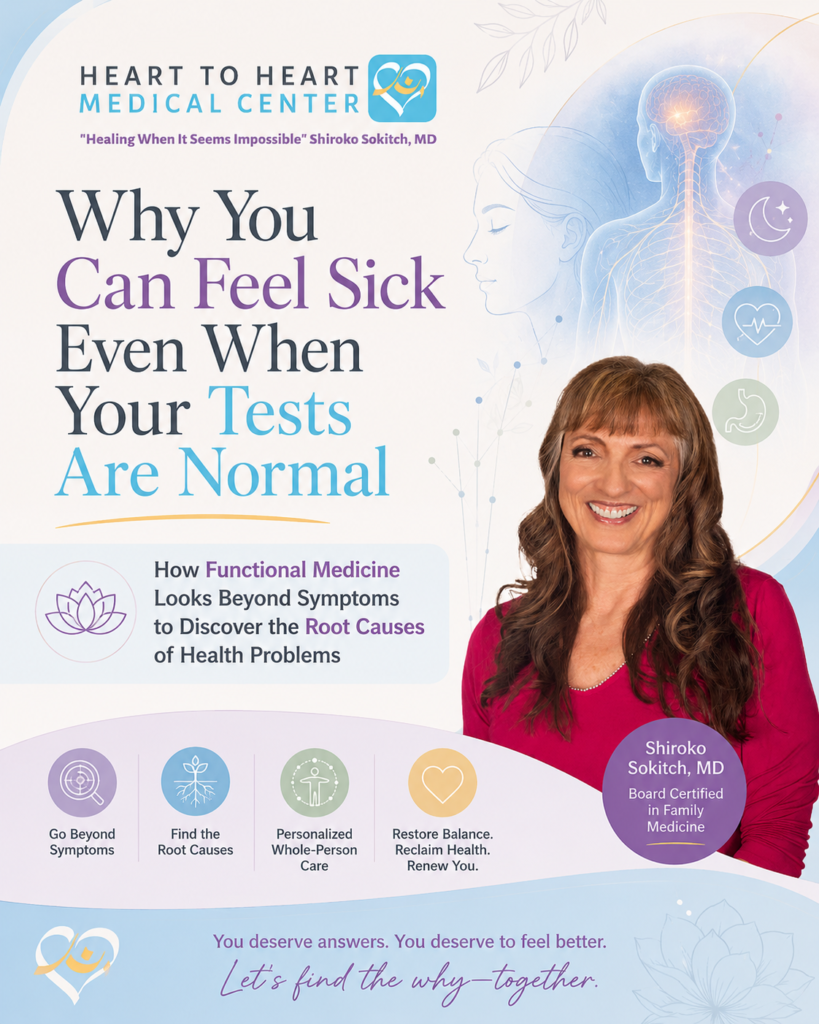
Why Do Some People Feel Unwell Despite Normal Test Results?
One of the biggest misconceptions in healthcare is that normal laboratory results automatically mean optimal health.
While conventional laboratory testing is incredibly valuable and often life-saving, standard testing is designed primarily to identify disease, not necessarily to evaluate every factor that may influence overall wellness.
This distinction is important.
Many people experience symptoms such as:
- Persistent fatigue
- Brain fog
- Digestive discomfort
- Sleep disturbances
- Joint pain
- Mood changes
- Low energy
- Hormonal concerns
Yet routine testing may not identify a clear explanation.
This does not mean the symptoms are imaginary. It simply means that the underlying contributors may require a broader investigation.
As I discussed during my live stream, functional medicine often begins with a detailed conversation about your health history. This history can provide valuable clues that may not appear on standard laboratory panels.
The Root-Cause Philosophy
One of the defining principles of functional medicine is that symptoms are not random.
They represent signals from the body.
For example:
- Chronic digestive symptoms may indicate imbalances within the gastrointestinal system.
- Persistent fatigue may reflect multiple overlapping factors affecting energy production.
- Joint discomfort may be influenced by inflammatory processes.
- Sleep disturbances may be connected to stress physiology, hormone regulation, or lifestyle patterns.
Not every symptom has a simple answer. Human health is complex.
However, functional medicine encourages us to ask deeper questions.
Looking Beyond the Diagnosis
A diagnosis is important.
Diagnoses help clinicians communicate, guide treatment decisions, and identify evidence-based interventions.
However, a diagnosis does not always explain why the condition developed.
During my live discussion, I used examples such as rheumatoid arthritis and ulcerative colitis. While these diagnoses provide a name for a condition, functional medicine seeks to understand the factors that may have contributed to its development.
Potential contributing factors may include:
- Chronic inflammation
- Environmental exposures
- Lifestyle influences
- Nutritional deficiencies
- Digestive dysfunction
- Immune system dysregulation
- Past and hidden infections
- Chronic stress
Understanding these contributors may provide opportunities to support overall health while continuing appropriate medical care.
How Functional Medicine Evaluates the Whole Person
Functional medicine often examines multiple interconnected systems, including:
Digestive Health
The digestive tract plays a critical role in nutrient absorption, immune function, and communication with the nervous system.
Research continues to demonstrate the importance of the gut microbiome and its influence on overall health.
Hormonal Balance
Hormones influence metabolism, mood, sleep, energy, and many other physiological functions.
Even subtle disruptions in hormonal signaling can affect how a person feels day to day.
Inflammation
Inflammation is a natural biological process.
However, chronic low-grade inflammation has been associated with numerous health concerns and may contribute to symptoms that affect quality of life.
Lifestyle Factors
Sleep quality, movement, nutrition, stress management, and social connection all influence health outcomes.
Functional medicine recognizes these factors as important components of a comprehensive care plan.
The Role of Chinese Medicine in an Integrative Approach
Before functional medicine became widely recognized, I was already studying Chinese medicine while practicing emergency medicine.
Chinese medicine offers a different framework for understanding health.
Rather than focusing solely on laboratory findings, it evaluates patterns of balance and imbalance within the body.
Historically, Chinese medicine developed long before modern diagnostic testing existed. Practitioners relied on observation, pulse assessment, symptom patterns, and clinical experience to understand a person’s condition.
While the language and concepts differ from Western medicine, many patients appreciate the emphasis on viewing health as an interconnected system.
Today, I integrate conventional medicine, functional medicine, and Chinese medicine because each perspective contributes valuable insights.
If You Only Do One Thing
Start paying attention to patterns.
Keep a journal of:
- Symptoms
- Sleep quality
- Energy levels
- Nutrition
- Stress levels
- Physical activity
Patterns often reveal valuable clues that can guide meaningful conversations with your healthcare team.
Common Mistakes People Make
Mistake #1: Assuming Normal Tests Mean Optimal Health
Normal results are important, but they do not always explain every condition.
Mistake #2: Focusing Only on Diagnosis
Diagnoses are important, but understanding contributing factors may provide additional insights.
Mistake #3: Looking for One Single Cause
Many chronic symptoms result from multiple interacting influences rather than one isolated factor.
Mistake #4: Ignoring Lifestyle Factors
Sleep, nutrition, stress, and movement can significantly influence overall well-being.
Mistake #5: Giving Up After One Evaluation
Health journeys are often complex and may require ongoing investigation and adjustment.
Frequently Asked Questions
Is functional medicine the same as conventional medicine?
No. Functional medicine is generally most effective when integrated with appropriate conventional medical care.
Can functional medicine replace my primary care physician?
No. Functional medicine is generally most effective when integrated with appropriate conventional medical care.
What conditions does functional medicine address?
Functional medicine is commonly used to explore chronic symptoms, mystery conditions that have no apparent diagnosis, digestive concerns, fatigue, metabolic health, hormone balance, and other complex health issues.
Is functional medicine evidence-based?
Functional medicine incorporates evidence-based research, systems biology, nutrition science, lifestyle medicine, and personalized care principles.
What is the biggest benefit of functional medicine?
For many people, it provides a more comprehensive understanding of the factors that may be contributing to their health conditions.
Conclusion
Functional medicine offers a different way of thinking about health.
Instead of focusing solely on disease labels, it seeks to understand the underlying factors that may be influencing symptoms and overall well-being.
As I shared during my recent live discussion, many patients are not simply looking for another diagnosis—they are looking for answers.
By combining the strengths of conventional medicine, functional medicine, and Chinese medicine, we can often gain a more complete understanding of health and create a more personalized path forward.
Your symptoms matter.
Your story matters.
And sometimes the most important question we can ask is not simply “What is this?” but “Why is this happening?”
References
Institute for Functional Medicine (IFM). Introduction to Functional Medicine.
National Center for Complementary and Integrative Health (NCCIH). Complementary, Alternative, or Integrative Health: What’s In a Name?
National Institutes of Health (NIH). The Human Microbiome and Health.
Harvard Health Publishing. Understanding Inflammation and Chronic Disease.
Cleveland Clinic. Functional Medicine: What It Is and How It Works.
Educational content only and not intended as medical advice. Always consult your healthcare professional regarding personal medical concerns.