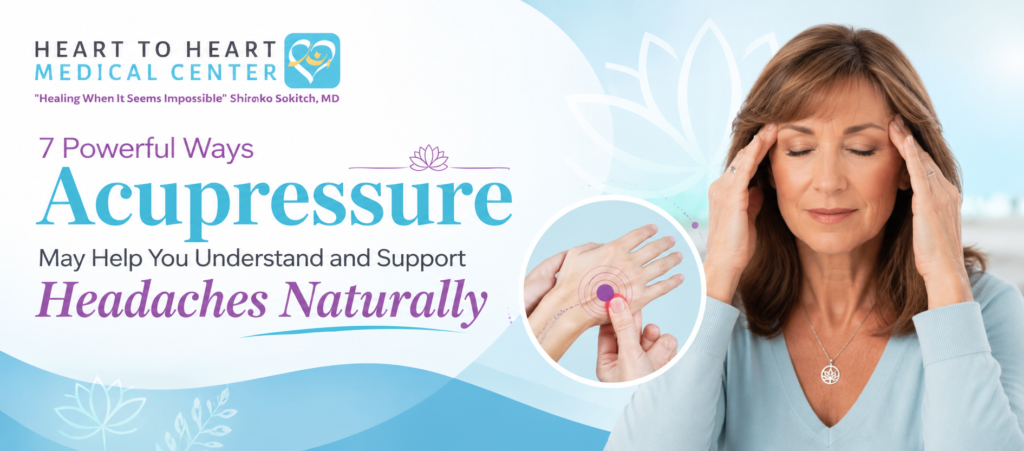
Here are 7 powerful tips to understand and support headaches relief naturally from a Functional and Chinese Medicine Guide for Headaches and Acupressure.
Headaches can feel simple on the surface. Your head hurts, you want it to stop, and you may reach for whatever has helped in the past.
But after many years of practicing integrative and functional medicine, I have learned that a headache is not always “just a headache.” The pain may be in the forehead, the temples, the back of the head, the top of the head, or it may feel like a tight band wrapping around the skull. It may come with stress, congestion, PMS, perimenopause, caffeine changes, digestive imbalance, food sensitivity, poor sleep, or neck tension.
That is why I like to begin with curiosity.
Where is the headache?
When does it happen?
What else is going on in your body?
What pattern is repeating?
In Chinese medicine, headache location can give us important clues. In functional medicine, we look for root causes and patterns. In Western medicine, we also pay attention to headache type, severity, red flags, and when medical evaluation is needed. These approaches do not have to compete with one another. When used wisely, they can create a more complete picture.
This article is educational and not a substitute for medical care. If you have sudden, severe, new, worsening, or unusual headaches, or a headache with neurological symptoms, fever, stiff neck, head injury, confusion, weakness, vision changes, or difficulty speaking, please seek medical care promptly. Mayo Clinic lists sudden “worst headache ever,” fever, stiff neck, confusion, seizures, double vision, weakness, numbness, difficulty speaking, or headache after head injury as warning signs requiring urgent medical attention.
Why Headaches Deserve a Root-Cause Conversation
Headache disorders are common and can be disabling. The World Health Organization describes headache disorders, including migraine, tension-type headache, and cluster headache, as among the most common nervous system disorders. The National Institute of Neurological Disorders and Stroke also distinguishes tension-type headaches from migraine, noting that tension-type headache typically does not include aura, nausea, or vomiting and usually is not worsened by everyday activity.
That matters because different headache patterns may need different kinds of support.
Some people have headaches related to muscle tension and stress. Some have migraine, which is a complex neurological condition. Some have hormonal migraine patterns. Some have sinus pressure or respiratory congestion. Some have headaches that are affected by caffeine inconsistency, sleep disruption, blood sugar shifts, dehydration, medications, or food triggers.
And some people have multiple patterns at once.
In my work, I do not want to simply ask, “How do we quiet the pain?” I want to ask, “Why is your body creating this pattern?” Sometimes the answer is simple. Sometimes it is layered. But the question itself changes the way we care for the body.
Headaches Through a Chinese Medicine Lens
In Chinese medicine, the organs are not understood only as physical structures. They are part of larger networks of function, energy, emotion, and communication. This is different from Western anatomy, and it is important not to confuse the two.
When I talk about the liver, gallbladder, lungs, large intestine, kidneys, or bladder in Chinese medicine, I am not saying that your Western medical organ is diseased. I am describing a pattern or channel system that may help us understand how symptoms are expressing themselves.
In the video that inspired this article, I explain that Chinese medicine does not see all headaches as the same. Headache location can help us think about which channel pattern may be involved, and different acupressure points may be used depending on the location and timing of the pain.
This is not a diagnosis. It is a way of listening.
Pattern 1: Frontal Headaches
A frontal headache is felt in the forehead, front of the face, or sometimes around the sinus area.
In Chinese medicine, this pattern may be connected to the lung and large intestine channels. The lung/large intestine system is associated with the respiratory tract, the nose, the throat, the skin, and the body’s protective boundary with the outside world, (otherwise known as the immune system). In a practical sense, many people notice frontal headaches when they are congested, fighting a cold, dealing with sinus pressure, or experiencing respiratory irritation.
In the video, I describe the common acupressure point between the thumb and index finger as a starting point many people use for this kind of headache pattern. This point is commonly known as LI4 or Hegu.
To try it gently:
- Find the soft web between your thumb and index finger.
- Use the thumb of your opposite hand to apply steady, comfortable pressure.
- Breathe slowly for 30 to 60 seconds.
- Notice whether the headache softens, shifts, or stays the same.
- Repeat on the other hand if appropriate.
Do not force the pressure. Acupressure should feel firm but tolerable, not sharp or aggressive.
Important safety note: Memorial Sloan Kettering advises avoiding LI4/Hegu if you are pregnant, and also avoiding acupressure on skin that has open wounds, rash, redness, swelling, warmth, pus, peeling, or blistering.
Pattern 2: Back-of-the-Head Headaches
Some headaches sit at the base of the skull or the back of the head. These may overlap with neck tension, posture, jaw tension, stress, or cervical alignment issues.
In Chinese medicine, the back-of-the-head pattern may be associated with the bladder and kidney channels. In the video, I describe a point near the outer ankle bone, between the Achilles tendon and the outer ankle, as a point that may be explored when the headache is located at the back of the head.
From a practical point of view, if your headache is consistently at the base of the skull, I also want to know about your neck. Do you work at a desk? Do you clench your jaw? Do you look down at your phone for long periods? Did the headache begin after an injury? Is it worse with movement?
Acupressure can be supportive, but recurring back-of-head headaches should not be ignored, especially if they are new, severe, or changing.
Pattern 3: Side-of-Head, Band-Like, PMS, Perimenopause, or Migraine-Type Headaches
The most common headache patterns I see in practice often involve the temples, sides of the head, top of the head, or a tight band-like sensation. These may appear around menstruation, during perimenopause, with intense stress, or alongside migraine patterns.
In Chinese medicine, these patterns often connect to the liver and gallbladder channels. The liver/gallbladder system is associated with the smooth flow of energy, stress regulation, emotional processing, and menstrual rhythm. In the video, I explain that PMS headaches, perimenopausal headaches, migraines, side-of-head headaches, band-like headaches, and top-of-head headaches may all fall into this broader liver/gallbladder pattern.
Western medicine also recognizes that hormone fluctuations can influence migraine. The American Migraine Foundation notes that estrogen changes can intensify migraine attacks, and for nearly two out of three women with migraine, attacks occur around the time of their period.
This is one of the reasons I never dismiss hormonal headaches as “just PMS.” If your headaches show up around your period, during perimenopause, or during times of stress, your body may be showing you a real physiological pattern that deserves support.
A Simple Acupressure Protocol for Headache Awareness
Here is a gentle self-check inspired by the video.
Step 1: Pause and Locate
Before pressing any point, ask:
Where is the headache strongest?
- Forehead/front of face
- Back of head/base of skull
- Temples/sides of head
- Top of head
- Band-like around the head
- Around the menstrual cycle
- After caffeine changes
- After certain foods
- After stress or poor sleep
Step 2: Try the General Hand Point
For many headaches, you may begin with the point between the thumb and index finger. Apply gentle, steady pressure for 30 to 60 seconds while breathing slowly.
Again, avoid this point during pregnancy unless guided by a qualified clinician.
Step 3: Match the Pattern
If the headache is frontal, notice whether the hand point gives relief.
If the headache is at the back of the head, gently explore the point near the outer ankle between the ankle bone and Achilles tendon, as described in the video.
If the headache happens around menstruation or feels migraine-like, the video describes working near the pinky toe, including the side of the nail and the base of the pinky toe.
If the headache feels stress-related, band-like, or located at the top or side of the head, the video describes a point between the big toe and second toe, as well as a point near the outer ankle toward the front of the ankle bone.
Step 4: Breathe and Observe
Pressing harder is not better. The goal is not to overpower the body. The goal is to listen.
Ask:
Did the pain soften?
Did it shift?
Did it stay the same?
Did another sensation appear?
Does this pattern repeat over time?
Step 5: Track the Pattern
Use a headache journal for two to four weeks. Track:
- Location of pain
- Time of day
- Menstrual cycle timing
- Stress level
- Sleep quality
- Caffeine amount and timing
- Food patterns
- Hydration
- Screen time
- Neck tension
- Weather changes
- Digestive symptoms
- Medications or supplements
A pattern often becomes clearer when it is written down.
What Research Says About Acupuncture, Acupressure, and Headaches
Acupressure and acupuncture are not identical, but they come from related traditions and often use similar points. The research base is stronger for acupuncture than for self-administered acupressure, but both are being studied.
The National Center for Complementary and Integrative Health reports moderate-quality evidence that acupuncture may reduce the frequency of migraines and moderate- to low-quality evidence that it may reduce the frequency of tension headaches. NCCIH also notes that complementary approaches studied for headache include acupuncture, biofeedback, massage, relaxation techniques, spinal manipulation, and tai chi, with promising evidence for some approaches and limited or conflicting evidence for others.
A 2010 study on acupressure and trigger points suggested that one month of acupressure treatment was more effective than one month of muscle relaxant treatment for chronic headache in that study population, though more research is needed before making broad claims. A 2022 network meta-analysis of acupuncture-related therapies for migraine concluded that conventional acupuncture showed significant effects on pain scores, migraine days, duration, and attack frequency, while also calling for more high-quality studies.
This is why I describe acupressure as a supportive tool. It may be helpful, accessible, and empowering, but it should be used within a broader care plan when headaches are chronic, severe, or complex.
The Caffeine Connection
Caffeine is one of the most misunderstood headache factors.
Some people feel that caffeine helps a headache. Others notice that caffeine triggers headaches. Still others are sensitive not to caffeine itself, but to inconsistent caffeine intake.
In the video, I explain that if you are sensitive to caffeine, changes in the amount or timing may contribute to headaches. The American Migraine Foundation notes that caffeine can be a trigger for some people with migraine, while for others, a cup of coffee may help during an attack; some migraine medications also contain caffeine.
This is why I do not tell everyone, “Never drink coffee.” Instead, I ask:
How much caffeine do you drink?
Do you drink it at the same time each day?
Do headaches happen when you skip it?
Do they happen when you drink more than usual?
Do they happen on weekends when your schedule changes?
For sensitive people, rhythm matters.
Food Sensitivities, Gluten, Dairy, and Chronic Headaches
In the video, I also mention that some people with chronic headaches improve when they explore gluten or dairy sensitivity. This does not mean everyone with headaches should permanently eliminate gluten or dairy. It means food patterns can be worth investigating thoughtfully, especially when headaches are frequent, unexplained, or accompanied by digestive, skin, fatigue, inflammatory, or hormonal symptoms.
The American Migraine Foundation recommends that people who suspect a food trigger can track whether a specific food corresponds with headaches and may consider eliminating that food for a period of time to see whether symptoms improve. Research on celiac disease has found an increased prevalence of headache among people with celiac disease and an increased prevalence of celiac disease among people with idiopathic headache. A 2024 review also notes research indicating a correlation between celiac disease and increased susceptibility to headaches, especially migraines.
A key caution: if you suspect celiac disease, speak with a clinician before removing gluten, because testing is most accurate while gluten is still in the diet. The National Institute of Diabetes and Digestive and Kidney Diseases describes celiac disease as a chronic digestive and immune disorder triggered by eating foods containing gluten.
For some people, an elimination-and-reintroduction plan can be useful. But it should be done carefully, ideally with guidance, so the diet does not become unnecessarily restrictive.
If You Only Do One Thing
If you only do one thing after reading this, start a headache pattern journal.
Do not make it complicated. For the next three headaches, write down:
- Where the pain is
- What time it started
- What you ate that day
- How much caffeine you had
- How well you slept
- Whether you were stressed
- Whether it was near your menstrual cycle or perimenopause symptoms
- Whether you had congestion, neck tension, digestive symptoms, or nausea
- What helped
This one practice can turn a confusing symptom into a clearer conversation.
Common Mistakes People Make With Headaches
Mistake 1: Treating every headache the same way
Different headache patterns may have different contributors. Location, timing, and associated symptoms matter.
Mistake 2: Ignoring red flags
Natural tools are wonderful, but they are not a replacement for urgent care when symptoms are severe, sudden, new, worsening, or neurologically concerning. The American Headache Society uses the SNOOP4 framework to help clinicians remember red flags for secondary headaches.
Mistake 3: Pressing too hard
Acupressure should not be painful. Gentle, sustained pressure is often more useful than aggressive pressure.
Mistake 4: Overlooking caffeine rhythm
If headaches happen on weekends, travel days, or mornings when coffee is delayed, caffeine inconsistency may be part of the pattern.
Mistake 5: Dismissing hormone-related headaches
PMS, perimenopause, and menstrual migraine patterns are real. They deserve support, not dismissal.
Mistake 6: Removing too many foods without a plan
Food sensitivity investigation can be helpful, but it should be structured. Track, eliminate thoughtfully, reintroduce carefully, and seek guidance when needed.
Frequently Asked Questions Related to Headaches and Acupressure
Can acupressure cure headaches?
No. I would not describe acupressure as a cure. Acupressure may help support relief for some people, and it can be a useful self-care tool, but recurring or severe headaches need proper evaluation.
Which acupressure point should I try first?
Many people start with the point between the thumb and index finger, often called LI4 or Hegu. Use gentle pressure and slow breathing. Avoid this point during pregnancy unless guided by a clinician.
What if acupressure does not help?
That is useful information. It may mean that point is not the best match for your pattern, or that your headache needs a different kind of support. Track the pattern and seek professional care if headaches are recurring, worsening, or disruptive.
Are hormonal headaches common?
Hormone fluctuations can influence migraine patterns. The American Migraine Foundation notes that for many women with migraine, attacks occur around the time of menstruation.
Should I eliminate gluten and dairy for headaches?
Not automatically. If you notice a pattern or have chronic headaches, food sensitivity exploration may be worth discussing with a clinician. If celiac disease is possible, get tested before eliminating gluten, because testing is more reliable when gluten is still being consumed.
A headache can be frustrating, exhausting, and disruptive. But it can also be a doorway into deeper understanding.
Instead of asking only, “How do I make this stop?” try asking, “What is my body showing me?”
Where is the pain?
When does it happen?
What pattern repeats?
What does my body need more of: rest, rhythm, hormone support, nervous system support, digestive care, hydration, clinical evaluation, or a deeper root-cause investigation?
At Heart to Heart Medical Center, my work is about helping people reconnect with their body’s natural ability to heal through a thoughtful blend of Western medicine, Chinese medicine, acupuncture, integrative medicine, and functional medicine. Dr. Shiroko Sokitch is board certified in Medical Acupuncture, Integrative Medicine, and Functional Medicine, and Heart to Heart Medical Center describes its mission as helping patients restore whole-body wellness through a root-cause approach.
If you are experiencing recurring headaches and want to understand the deeper pattern, I invite you to learn more about our integrative and functional medicine approach. Internal link suggestion: connect the phrase “Functional Medicine in Santa Rosa, CA” to Heart to Heart Medical Center’s functional medicine service page. Internal link suggestion: connect “Initial Visit with Dr. Shiroko” to the initial visit page.
Your body is not just creating noise. It may be asking to be heard.
Educational disclaimer: This article is for educational purposes only and is not medical advice. Please consult a qualified healthcare professional for diagnosis and treatment, especially if headaches are sudden, severe, recurring, worsening, or associated with neurological symptoms.
References
- National Center for Complementary and Integrative Health: headaches and complementary approaches.
- National Center for Complementary and Integrative Health: acupuncture effectiveness and safety.
- World Health Organization: migraine and headache disorders.
- National Institute of Neurological Disorders and Stroke: headache information.
- Mayo Clinic: headache red flags and when to seek care.
- American Migraine Foundation: caffeine and headaches.
- American Migraine Foundation: hormonal and menstrual migraine.
- American Migraine Foundation: migraine diet and trigger tracking.
- Hsieh et al., acupressure and chronic headache.
- Celiac disease and headache systematic review.