

What Is My Body Trying to Tell Me? How to Notice Patterns
By Shiroko Sokitch, MD
Have you ever reached the end of a busy day and felt completely exhausted? Or woken up after eight hours of sleep and wondered why you still didn’t feel rested?
When you find yourself asking, “What is my body trying to tell me?” a helpful place to start is noticing patterns.
One of the things I teach my patients is how to listen to their bodies. Paying attention to your energy, sleep, digestion, and daily rhythms gives us a clearer picture of what you’re experiencing. It also helps us understand what you want to improve.
My mission is to help you feel great doing the things you love. That means having the energy and vitality to spend time with the people who matter to you and participate in the life you want to live.
Listening to your body is one place we can begin.
When an Occasional Experience Becomes a Pattern
Feeling tired after an unusually demanding day is one experience. Feeling exhausted at the end of every day gives us something more to explore.
The same is true of waking up tired. You might have an occasional morning when you don’t feel refreshed. But when that becomes your everyday experience, it deserves attention.
Consider what happens after you eat. Do you usually feel comfortable and energized, or do you repeatedly notice bloating, gassiness, or fatigue?
One of my patients noticed that spicy foods consistently left her feeling bloated. Recognizing that connection helped her understand which foods weren’t working well for her.
Your observations give us a starting point. When something happens repeatedly, we can explore the circumstances around it and how it affects you.
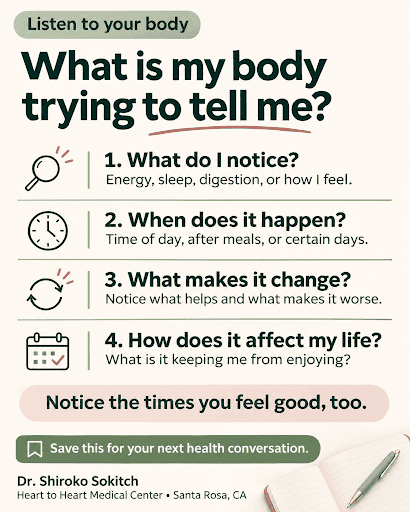
Four Questions to Help You Listen to Your Body
Start with something you’ve noticed. If you’re asking, “What is my body trying to tell me?” these four questions can help you describe what keeps happening.
1. What am I noticing?
Describe the experience as simply as you can.
Perhaps you wake up feeling tired. Maybe your energy drops in the afternoon, you feel bloated after meals, or you have trouble falling asleep.
Pay attention to the times you feel good, too. When do you feel most alert? When do you have the energy to enjoy what you’re doing?
Those moments help us understand your experience more fully.
2. When does it happen?
Timing can add useful detail.
Does your fatigue appear when you first wake up, after lunch, or toward the end of the workday? Do you wake during the night at a similar time? Does difficulty sleeping happen on certain days of the week or at particular times of the month?
You might notice a difference between workdays and days off, or between days when meals are rushed and days when you have time to sit down.
Try to describe what you observe without needing to explain the cause immediately.
3. What makes it change?
Think about what happens before you feel different and what seems to help.
Some of my patients notice that eating gives them energy. Others feel more tired after a meal. What they eat, how they eat, and what is happening with their digestion are all details worth exploring.
You can also notice whether your experience changes after rest, a different routine, or a particular activity.
A useful observation might sound like this: “I felt comfortable after breakfast, but I noticed bloating after lunch on three different days.”
That gives us more information than simply saying, “My digestion feels off.”
4. How is it affecting my life?
This is an important part of the conversation.
Are you going to bed earlier because you’re too tired to enjoy the evening? Are you choosing different foods because you’re worried about feeling uncomfortable? Is interrupted sleep making it harder to concentrate or spend time with your family?
Tell me what you’re missing and what you would like to feel able to do again.
Helping you feel better includes understanding what feeling better would make possible in your life.
How I Look at Patterns in My Practice
In my practice, I bring together my medical training and Chinese medicine to understand what you’re experiencing.
Chinese medicine pays attention to daily rhythms and patterns involving energy, digestion, and sleep. When you tell me when you feel tired, when you feel alert, or when your sleep is interrupted, those details become part of the larger picture we explore together.
I consider that information alongside your health history, symptoms, and medical evaluation. A particular time of day is one observation within that picture; it does not establish a diagnosis by itself.
You don’t need to interpret everything before your appointment. Bring your observations and your questions. Part of my work is helping you make sense of them.
A Simple Way to Record What You Notice
When you catch yourself asking, “What is my body trying to tell me?” make a quick note on your phone or in a notebook while the details are fresh.
For each experience, record:
What you noticed: Describe the symptom or change.
When it happened: Include the time and relevant circumstances.
What changed it: Note anything that seemed to improve or worsen it.
How it affected you: Explain what became difficult or what you did differently.
For example: “I woke at 3 a.m. and had trouble getting back to sleep. By the afternoon, I felt too tired to enjoy my usual activities.”
You can also record a positive experience: “I felt alert this morning and had enough energy to spend time outside with my family.”
Keeping notes is an established way to support a medical conversation. The National Institute of Diabetes and Digestive and Kidney Diseases describes using a food-and-symptom diary to investigate gas symptoms. The National Heart, Lung, and Blood Institute similarly recommends sleep diaries to help patients describe their sleep and daytime tiredness.
Keep your notes manageable. A clear description is useful even when you haven’t identified an obvious pattern.
Here’s what a few days of notes might look like. On Monday, you felt alert through the morning and tired around 2 p.m. after eating lunch at your desk. On Tuesday, you noticed a similar dip after a sit-down lunch. On Wednesday, you felt alert through the afternoon, even though you ate at about the same time.
When you look back, include the day that felt different. You might write, “I felt tired around 2 p.m. twice this week, and both times it was hard to finish my work. On Wednesday I felt fine. I’d like to understand what might account for the difference.” That gives us a clearer starting point for the conversation.
If you have several observations, start with the one that affects your day most. Bring a typical example, a day that felt different, and one question you want time to discuss. You might ask, “What details would help us understand why this keeps happening?” You can keep the rest of your notes handy if you need to refer to them.
When to Ask for Help Understanding Your Symptoms
You can bring a concern to your doctor whenever it is troubling you. Repeated fatigue, waking unrefreshed, disrupted sleep, or digestive discomfort are worth discussing, especially when they interfere with everyday life.
You don’t need to wait until you have collected weeks of notes or figured out what is causing the problem.
For sudden or severe symptoms, seek prompt medical care rather than waiting to observe a pattern.
Let’s Talk About What You Want to Feel Better Doing
What is happening in your body that you would like to improve right now?
Perhaps you want to wake up feeling refreshed, enjoy meals more comfortably, or have energy left for the people you love at the end of the day.
At Heart to Heart Medical Center in Santa Rosa, CA, I help patients explore these concerns and develop a personalized approach to their care.
Book a complimentary 15-minute consultation through the Heart to Heart Medical Center website to talk about your concerns and learn more about working with me.
I’m also hosting a free health-planning webinar on Wednesday, November 25, 2026, where we’ll explore how to begin planning for the health and life you want. I would love for you to join me.
Frequently Asked Questions
What should I write down before talking with my doctor?
Record what you notice, when it happens, anything that changes it, and how it affects your life. Include your questions and what you hope to improve.
Should I track the times I feel good, too?
Yes. Noticing when you feel rested, alert, and comfortable helps describe your daily experience more completely.
Do I need to understand what a pattern means before making an appointment?
No. Your observations are enough to begin a conversation. Your practitioner can help you explore possible explanations and decide on appropriate next steps.
References
National Institute of Diabetes and Digestive and Kidney Diseases. Diagnosis of Gas in the Digestive Tract. https://www.niddk.nih.gov/health-information/digestive-diseases/gas-digestive-tract/diagnosis
National Heart, Lung, and Blood Institute. Sleep Deprivation and Deficiency: Diagnosis. https://www.nhlbi.nih.gov/health/sleep-deprivation/diagnosis-treatment