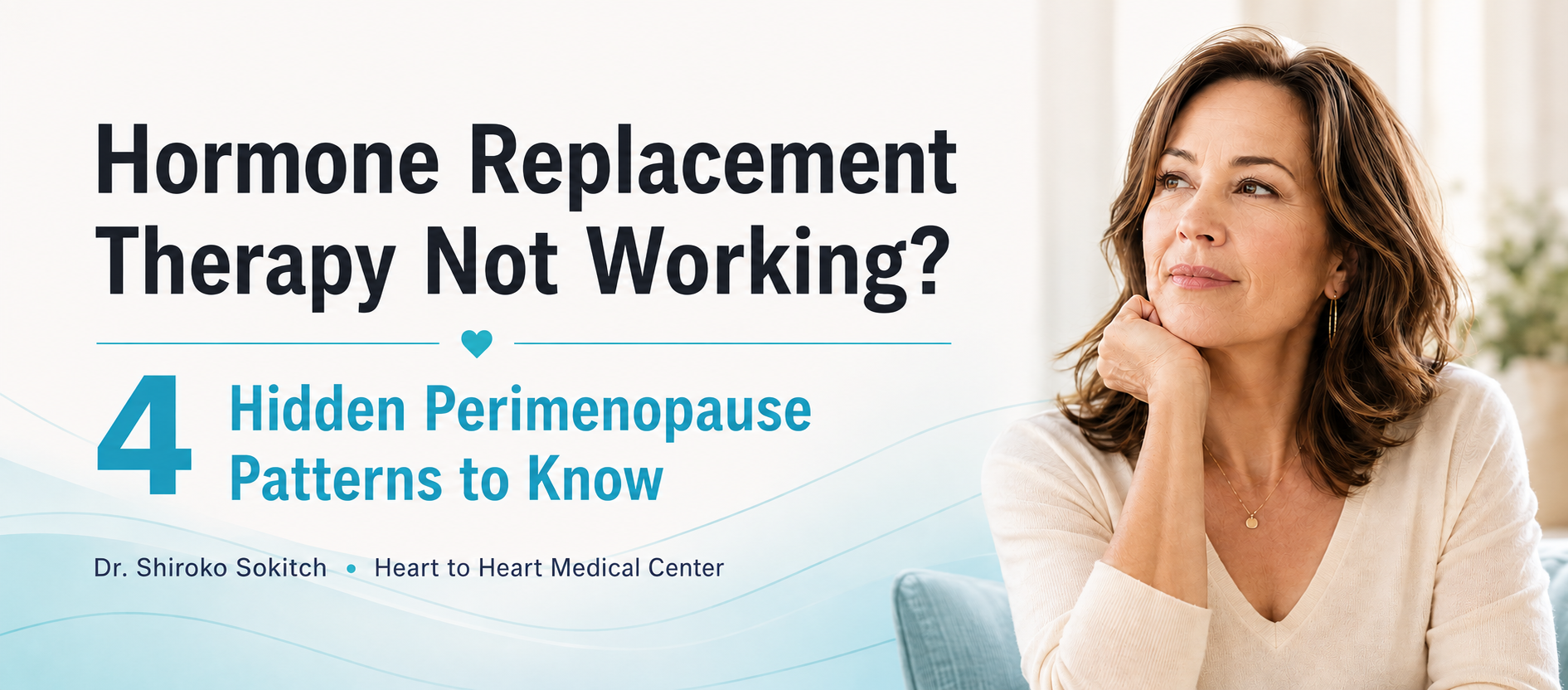
Hormone balance in perimenopause can affect far more than a woman’s cycle. It can influence sleep, mood, energy, temperature regulation, stress resilience, and the way a woman feels in her own body.
For some women, hormone balance begins to shift with PMS, migraines around the cycle, irritability, or irregular periods. For others, hormone balance becomes a bigger concern during perimenopause, when hot flashes, night waking, poor sleep, and feeling unlike yourself begin to take center stage.
I want women to know this: these symptoms are not random. They are signals.
In my practice, I believe hormone balance deserves a broader and more compassionate conversation. Hormone replacement therapy can be helpful for some women, but not every woman wants that path. Some are cautious because of family history. Some do not feel comfortable starting hormones. Others simply want to know what else may support hormone balance in perimenopause in a natural, practical, and integrative way.
That is one reason I value Chinese medicine. It gives us another way to understand hormone balance, especially during transitions like perimenopause, when the body is asking for more support, not more force.
Table of Contents
- What hormone balance in perimenopause really means
- How Chinese medicine understands hormone balance
- Why hormone balance can feel harder during perimenopause
- Common signs your hormone balance may need support
- 7 powerful ways I support hormone balance in perimenopause
- A simple acupressure practice for hormone balance
- When to seek personalized help for hormone balance
- Final thoughts on hormone balance in perimenopause
What Hormone Balance in Perimenopause Really Means
When most people hear the phrase hormone balance, they think only of hormone levels on a lab report. But hormone balance in perimenopause is not just about numbers. It is also about how well the body is adapting to change.
Perimenopause is a transition, not a switch. During this time, estrogen and progesterone can fluctuate in ways that affect many systems at once. That is why one woman may notice hot flashes, while another struggles more with anxiety, sleep disruption, migraines, irregular bleeding, or mood swings.
Hormone balance in perimenopause is really about helping the body regulate more smoothly through this transition. It is about supporting sleep, nervous system stability, nourishment, circulation, energy, and resilience. It is also about listening to symptoms earlier instead of waiting until the body feels depleted.
This is where an integrative perspective can be so helpful. Rather than asking only, “What symptom do I want to get rid of?” I also ask, “What pattern is the body showing me, and what kind of support does it need?”
How Chinese Medicine Understands Hormone Balance
Chinese medicine gives us a different framework for understanding hormone balance. It does not approach the body in exactly the same way as Western medicine. Instead, it looks at patterns, relationships, and the way energy, nourishment, heat, rest, and resilience are expressed through the body.
When I think about hormone balance through the lens of Chinese medicine, two systems often matter a great deal: the liver and the kidneys.
The liver and hormone balance
In Chinese medicine, the liver is associated with the smooth flow of energy throughout the body. It also has an important relationship to the menstrual cycle. When that flow is disrupted, hormone balance can feel more fragile.
This may show up as:
- PMS
- irritability
- breast tenderness
- headaches or migraines around the cycle
- mood shifts
- irregular periods
When I see these patterns, I think about how to support smoother flow, better regulation, and less internal tension.
The kidneys and hormone balance
The kidneys, in Chinese medicine, are associated with deeper reserves. They relate to energy, life transitions, bones, resilience, and the body’s foundational strength. This becomes especially important when we are talking about hormone balance in perimenopause and menopause.
Perimenopause is a time when the body is changing at a deeper level. Women may notice that they cannot recover as easily from poor sleep, stress, overwork, or undernourishment. That does not mean they are weak. It means the body is asking for a different kind of care.
Chinese medicine helps us recognize that hormone balance is not only about managing symptoms. It is also about restoring support where the body feels depleted, overheated, restless, or out of rhythm.
Why Hormone Balance Can Feel Harder During Perimenopause
One of the most useful ways I explain hormone balance in perimenopause is through the relationship between yin and yang.
Yin is cooling, nourishing, restorative, and inward. Yang is warming, activating, energizing, and outward. Both are necessary. Health depends on their dynamic balance.
During perimenopause, estrogen and progesterone begin to shift and decline. In Chinese medicine, part of this transition can be understood as a decline in yin. When yin becomes less abundant, relative heat and activation may rise.
This can help explain why hormone balance in perimenopause often feels different than it did in earlier years.
A woman may notice:
- hot flashes
- night sweats
- restlessness
- poor sleep
- waking between 2 and 4 a.m.
- feeling overheated at night
- increased anxiety or irritability
- a sense of being tired but wired
In simple terms, the body may be losing some of the cooling, grounding, and nourishing influence that helps it settle and restore. This is why women often tell me, “I do not feel like myself anymore.”
That feeling matters. It is often a clue that hormone balance needs support at a deeper level. Here is an article from Harvard University that talks about “Understanding Hormone Therapy for Menopausal Symptoms” for more information.
Common Signs Your Hormone Balance May Need Support
Hormone balance in perimenopause does not look exactly the same for every woman. Symptoms can vary, and they can change over time.
Here are some of the more common signs I watch for when hormone balance needs attention:
- irregular cycles
- shorter or longer cycles
- heavier or lighter bleeding
- PMS that feels worse than before
- headaches or migraines around the cycle
- hot flashes
- night sweats
- difficulty falling asleep
- waking in the middle of the night
- fatigue
- mood swings
- anxiety
- brain fog
- feeling depleted after stress
- lower stress tolerance
- feeling unlike yourself
These symptoms are not something I want women to dismiss. They are often the body’s way of asking for more thoughtful, individualized support.
7 Powerful Ways I Support Hormone Balance in Perimenopause
When I help women navigate hormone balance in perimenopause, I do not believe in a one-size-fits-all plan. I look at the whole person, the pattern of symptoms, and the level of depletion or dysregulation that may be present.
Here are seven of the most important areas I consider.
1. I start with the whole pattern, not just one symptom
A hot flash is never just a hot flash to me. Poor sleep is never just poor sleep. I want to understand when symptoms happen, what makes them worse, how the cycle has changed, how stress is affecting the body, and what the woman’s daily life looks like.
Hormone balance improves when we stop treating the body like a list of disconnected complaints and begin seeing the bigger picture.
2. I support hormone balance with acupuncture
Acupuncture can be a valuable part of an integrative plan for hormone balance in perimenopause. It offers a way to support regulation, restore flow, calm internal tension, and help the body shift out of patterns of stress or depletion.
Some women notice support with sleep, stress, hot flashes, cycle symptoms, or a general sense of feeling more regulated in their body.
I often think of acupuncture as a way of helping the body remember how to settle.
3. I consider Chinese herbs when appropriate
Chinese herbs can be another supportive tool for hormone balance, especially when symptoms follow a clearer pattern. Herbs are not one-size-fits-all. They should be matched to the individual.
For one woman, the priority may be cooling and settling. For another, it may be nourishment and restoration. For someone else, it may be supporting smoother flow and easing irritability or tension around the cycle.
This is why individualized care matters so much.
4. I pay close attention to sleep
Sleep is one of the most important foundations for hormone balance in perimenopause.
When sleep is disrupted, the body becomes less resilient. Stress feels bigger. Cravings increase. Mood becomes more fragile. Recovery suffers. The nervous system loses some of its buffering capacity.
If a woman is waking at night, overheated, restless, or unable to settle, I take that seriously. Supporting hormone balance often starts with restoring more of the conditions that allow the body to rest.
That may include:
- a consistent bedtime
- dimmer lights at night
- less screen exposure before bed
- gentler evenings
- fewer stimulants late in the day
- a more calming wind-down routine
These may sound simple, but simple does not mean small.
5. I help women regulate stress, not just endure it
Many women are trying to survive perimenopause while carrying stress, responsibility, caregiving, overwork, and chronic emotional load. The body feels that.
Hormone balance is harder to maintain when the nervous system is constantly bracing.
I want women to know that stress support does not have to be complicated. Gentle, repeatable practices can make a real difference.
That may include:
- slow breathing
- walking
- quiet reflection or prayer
- time outside in morning light
- nervous system regulation practices
- moments of stillness during the day
- reducing the habit of running on empty
The goal is not perfection. The goal is to help the body feel safer and less overdriven.
6. I use nourishment as part of hormone balance support
Women often try to push through hormone symptoms by doing more, eating less, or demanding more from their body. In my experience, that usually backfires.
Hormone balance in perimenopause improves when the body feels nourished, not depleted.
I encourage women to pay attention to:
- protein intake
- blood sugar steadiness
- hydration
- mineral support
- regular meals
- gentle, supportive movement instead of punishment
When the body feels underfed, overtired, and overstressed, hormone balance becomes harder to sustain.
7. I keep the plan integrative and individualized
Some women want support without hormone therapy. Some want acupuncture and herbs. Some want lifestyle support first. Some benefit from a broader plan that may also include bioidentical hormones.
I do not believe this has to be an either-or conversation. Hormone balance in perimenopause often improves most when care is individualized.
My goal is never just to silence symptoms. My goal is to help the body regulate, adapt, and move through this transition with more stability, clarity, and resilience.
A Simple Acupressure Practice for Hormone Balance
In my live video, I also shared a simple acupressure area around the knees that may be supportive for hormone balance.
These points are found just below the knee joint, on the inner and outer sides of the lower knee area. Using gentle pressure, massage these areas for 30 to 60 seconds on each side while breathing slowly.
This is not a replacement for personalized medical care. It is simply one supportive practice that may help women feel more connected to their body and more engaged in their own healing process.
I love acupressure because it is simple, accessible, and empowering. It gives women a practical way to support hormone balance in perimenopause at home. Here is a link for you to read if you are going to ask, “Why Can’t I Lose Weight in Perimenopausal?“
When to Seek Personalized Help for Hormone Balance
Sometimes hormone balance needs more than general support. If symptoms are persistent, worsening, or significantly affecting daily life, it is important to seek personalized care.
Please do not ignore symptoms such as:
- very heavy bleeding
- severe sleep disruption
- frequent migraines
- marked anxiety or depression
- rapidly changing cycles
- significant fatigue
- symptoms that feel out of proportion or new for you
Women deserve answers. They also deserve care that takes their symptoms seriously.
Final Thoughts on Hormone Balance in Perimenopause
Hormone balance in perimenopause is about more than hormones. It is about how the whole body is adapting to change.
If you are dealing with PMS, migraines around your cycle, irregular periods, hot flashes, poor sleep, or feeling unlike yourself, I want you to know this: your symptoms are not random. They are messages.
You do not have to choose between suffering in silence and forcing yourself into only one path. There are many ways to support hormone balance in perimenopause, and the right plan is the one that fits your body, your history, and your goals.
This is why I believe in an integrative perspective. Chinese medicine, acupuncture, herbs, acupressure, sleep support, nourishment, nervous system regulation, and individualized care can all be part of a more compassionate conversation around hormone balance.
If your body has been asking for support, listen to it. There are answers, and there are options.